

Editorial Note
If you’re new to Dr. Greg L. Bahnsen’s teaching on Sola Scriptura, we recommend beginning with the short presentation below.
Rather than summarizing the seminar itself, this brief introduction highlights one of its central themes and prepares you for Dr. Bahnsen’s complete Sola Scriptura Series.
We designed these resources to work together, helping you move from introduction…to reflection…to in-depth study.
Listen to the presentation below, then continue reading.
Scripture Alone: Why Every Doctrine Depends on Who Gets the Final Say
Two people can read the same Bible and walk away believing opposite things.
Picture a husband and wife arguing about what a passage means. Both have read the same words but have come to different interpretations. And at some point, one of them reaches outside the text to settle it: “Well, my pastor says…” Notice that reflex. It happens to all of us, in one form or another, more often than we’d admit. The moment two readings collide, we go looking for anything to break the tie.
Somebody, or something, has to get the final word.
Four hundred years before that argument played out in living rooms, it was already playing out between Rome and a small movement of Reformers about to split Western Christianity in two. And the split wasn’t about grace, or about how a person becomes right with God, though both mattered enormously. It was first about the referee. Who gets to settle it when Christians disagree about what The Lord has said?
The problem of biblical inerrancy, the problem of biblical authority,
Greg L. Bahnsen: Sola Scriptura
is presuppositional in character. It’s the question of
what one takes as his final authority.
Rome’s answer combined the Bible with the church’s own tradition, with the church’s living voice authorized to explain what that tradition meant. The Reformers gave a different answer, eventually compressed into two Latin words still printed in seminary textbooks: Sola Scriptura. Scripture alone.
Dr. Greg L. Bahnsen spent years defending that phrase, not as a talking point but as a claim that had to hold up under real scrutiny. That pressure came from every side. Rome pressed it from one angle: how could two written pages settle every dispute without someone alive to interpret them? Liberal and neo-orthodox scholars pressed it from another: what happens to “Scripture alone” once you admit the Bible gets things wrong here and there? And a quieter objection came from inside Protestantism itself: isn’t “Sola Scriptura” just as human an invention as anything Rome came up with?
Three lectures, three rooms, three audiences. Strip away the occasion for each one, though, and the same question sits underneath all of them: every claim needs some final court of appeal. That court can’t be shared by two competing authorities without one eventually swallowing the other.
Move the hinge, and the whole door comes off its frame.
Why Every Disagreement Eventually Needs a Referee
Not every belief you hold carries the same weight. You believe it’s Tuesday, or that you heard a dog bark outside a minute ago. Show decent evidence otherwise, and you’ll shrug and let it go. But try convincing someone God doesn’t exist, and watch how differently that argument goes.
Philosophers call the second kind control beliefs: ideas so basic to how a person sees the world that they end up judging everything else, rather than being judged by it. You don’t test a control belief against some deeper premise standing behind it, because there isn’t one. It’s the floor you’re standing on.
Bahnsen, drawing on the philosopher Cornelius Van Til, put the Bible’s authority in exactly this category. You can’t settle it by appeal to some neutral referee both sides already trust, because the argument itself is about who gets to be referee. Every worldview has already answered that, whether it’s said so out loud.
So here’s the question worth sitting with before we go further: when your deepest conviction about God collides with someone else’s, what actually breaks the tie?
Not a rule. Not a vote. Something, or someone, has to sit above the disagreement, unquestioned, or the disagreement never ends. The Reformers’ answer was that the Bible holds that seat, and holds it alone. The Bible was to be the last word on whatever it speaks to, not tradition running alongside it as backup.
Here’s the catch. That claim only works if nothing else is quietly sitting in the room acting as a second judge. The instant a second authority joins Scripture, you need a plan for what happens when the two disagree. Something has to yield, and whatever yields has just been demoted. It’s no longer the final word. It’s a secondary source, useful until it isn’t.
Two Sources, One Winner
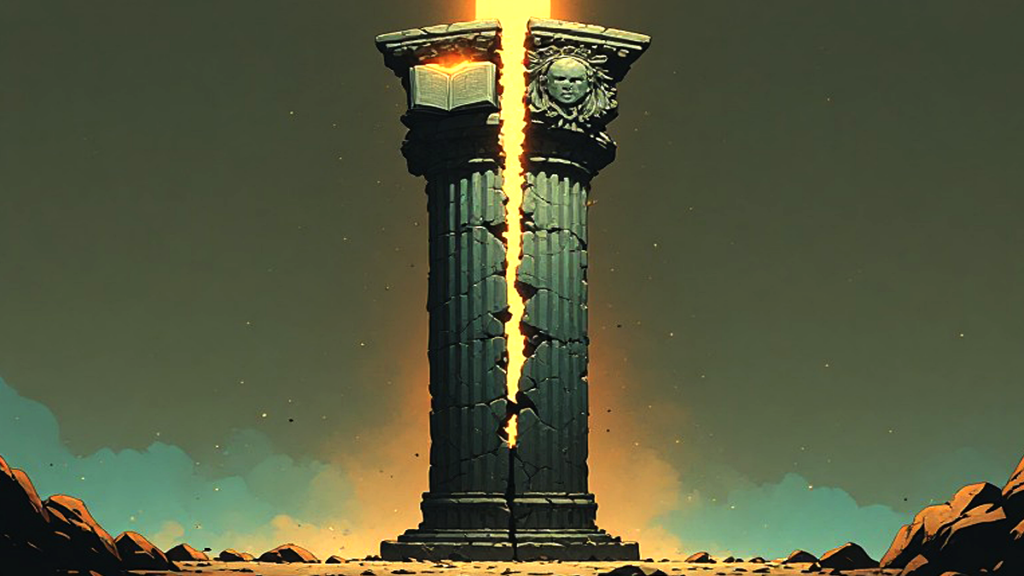
Rome was honest about running two tracks at once. At the Council of Trent, the church declared that saving truth comes down through Scripture and through unwritten tradition together, both received with equal reverence. On paper, that sounds like simple addition: Scripture keeps its authority, tradition just joins as a partner. In practice, it didn’t play out that way.
Look at what ended up resting on tradition rather than any direct command of Scripture: the priesthood, the Mass, purgatory, prayers for the dead, the veneration of Mary, clerical celibacy, eventually the papal office. None of it came with a scriptural mandate. All of it came from tradition. And once tradition became the authorized interpreter of Scripture, disagreeing with the church’s reading of a text became functionally the same as disagreeing with the text itself. The second source never stayed a partner. It climbed on top.
This isn’t a grievance sixteenth-century Reformers invented from nowhere. Jesus ran into the same dynamic in his own century. He told the Pharisees plainly that they had made the word of God void through their tradition (Matthew 15:3–6). Void, not improved. Paul says something close to identical to the church at Colossae, warning against being taken captive by a philosophy rooted in human tradition rather than in Christ (Colossians 2:8). In both cases, tradition itself was never the problem. Every family, every church has traditions, and most of them do no damage at all. The problem was tradition getting handed a vote equal to Scripture’s, and then, quietly, a vote greater than it.
That’s the same drift you’d recognize in any family whose traditions eventually stop answering to anything. A recipe passed down by memory alone, generation after generation, will always change a little. Someone adds a pinch of something, someone else “corrects” it back, and eventually nobody can say for certain which version is actually the original. That’s harmless at a dinner table. It stops being harmless the moment the recipe is claiming to be The Lord’s own instructions.
John Calvin saw the drift clearly, and didn’t dress up his language. Answering Cardinal Sadoleto’s appeal for Geneva to return to Rome, he called the pope’s rule over the church a kind of tyranny, language that makes a modern reader wince. But look underneath the sharp words at what he was actually objecting to: a human office handed the authority to overrule The Almighty’s plain word whenever that word proved inconvenient. He was watching one authority quietly eat another, and he wanted the church to see it happening too.
What This Doctrine Doesn’t Claim
A slogan travels faster than its explanation, and “Scripture alone” has picked up baggage over the years it wasn’t meant to carry. Most objections to the doctrine are really objections to a caricature of it.
It doesn’t mean the Bible replaces every kind of knowledge. Nobody opens Scripture to learn how to perform surgery or fix a car. The claim is narrower: on matters of doctrine and life before God, the Bible gets the final vote, not every vote on every subject. Historical study and commentaries aren’t dismissed either. Understanding the world the biblical writers lived in isn’t at odds with their authority; it helps a reader hear them correctly. A Christian who refuses every outside resource in the name of “just me and my Bible” isn’t practicing Sola scriptura. He’s practicing isolation the doctrine never asked for.
Let’s explain what Sola Scriptura does not mean… it doesn’t mean
Greg L. Bahnsen: Sola Scriptura
that if you’re going to have open-heart surgery, you
turn to the Bible to find out how to do it..
Nor does it reduce theology to stacking verses like building blocks, either. Real theology carries biblical truth into questions the original writers didn’t directly address, harder work than quotation, and Sola Scriptura never promised otherwise. And it required no printing press to have been true. Long before ordinary believers owned personal Bibles, the church’s standard was still Scripture, reaching most people through preaching rather than private reading.
Last, it isn’t a dismissal of church history. Calvin made that point forcefully against critics who accused the Reformers of tossing out the wisdom of the early church. Respecting the past and testing every human voice, ancient or modern, against Scripture created no tension for the Reformers. The church fathers earned honor precisely because they, like everyone else, were meant to answer to the same final standard.
Why the Stakes Are Higher Than a Debate
Think about the husband and wife again for a moment: the ones reaching for “well, my pastor says” to settle their disagreement. It feels like a small moment. Scripture treats it as anything but.
Twice, in very different parts of the Bible’s story, God attaches serious consequences to tampering with his word. In Deuteronomy, Moses tells Israel not to add to what The Lord commanded, and not to take anything away, because obeying the commandments as given, not as edited, is what faithfulness looks like (Deuteronomy 4:2). Centuries later, at the very end of the New Testament, John’s warning has even sharper teeth: whoever adds to this book will have plagues added to him; whoever takes away from it will lose his share in the tree of life (Revelation 22:18–19). That’s not the language of a minor disagreement. That’s covenant language, reserved for the highest stakes there are.
Paul draws a related line to Corinth, setting the wisdom of clever human argument against the truth revealed by The Holy Spirit, and telling believers their faith shouldn’t rest on the first (1 Corinthians 2:4–5). Jeremiah drew the same line centuries earlier, against prophets who spoke visions out of their own imagination instead of words that had actually come from The Lord (Jeremiah 23:16, 25–26). The pattern isn’t that human wisdom is always wrong. It sometimes gets things right. What matters is that God’s people aren’t supposed to lean their faith’s full weight on it, because it was never built to carry that weight.
Once you notice that pattern, the fight between Rome and the Reformers stops looking like church politics. It starts looking exactly like the question those older warnings were guarding against: has something been added to Jehovah’s word and handed equal, or greater, authority?
Why a Bible With Mistakes Couldn’t Do This Job
Here’s where the argument stops being about history and becomes something closer to plain logic, the piece Bahnsen returned to again and again once the conversation moved from Rome to the modern university.
Suppose, just for the sake of argument, the Bible contains real mistakes. Not copying errors better manuscripts could fix, but genuine wrong claims woven into what the text teaches. What happens to “Scripture alone” at that point?
Think about how you trust any source of information. If what you’re relying on is completely reliable, you can rest a belief entirely on it. But if it sometimes gets things wrong, you can’t just depend on it and stop there. You need some way to sort what’s trustworthy from what isn’t. You need a second authority, an outside referee, to tell you which parts of your source to keep and which to throw out.
Apply that to the Bible. If Scripture is entirely true, you can build a belief on the simple fact that Scripture teaches it. That’s what the Westminster Confession means calling the Holy Spirit speaking in Scripture the final judge of every doctrine (Westminster Confession of Faith, 1.10). But that confidence only holds if Scripture holds up across the board. Grant real errors, and the fact that the Bible teaches something no longer guarantees it’s true. It might be one of the mistaken parts.
At that point you need a screening authority: something standing over the text to sort the reliable claims from the unreliable ones. And whatever acquires that job has just quietly taken the seat “Scripture alone” was supposed to occupy. This is the same move you’d catch a family member making with the disputed recipe: the moment memory by itself can’t be trusted, somebody has to be appointed to decide which version counts, and that person, not the recipe, becomes the real authority in the room.
Unless the Scripture is infallible, unless the Scripture is inerrant,
Greg L. Bahnsen: Sola Scriptura
there’s no ground for holding to Sola Scriptura.
Modern theology has offered plenty of candidates for that seat: the assured results of scholarship, personal religious experience, the church’s evolving self-understanding. Different names, same move underneath. This is why Bahnsen treated inerrancy, Scripture not getting anything wrong in what it teaches, not as an extra requirement bolted on for the overly cautious, but as the condition that makes the whole doctrine possible in the first place. Take it away, and “Scripture alone” doesn’t shrink. It disappears, because something else always has to be recruited to do the screening Scripture itself can no longer be trusted to do.
There’s a deeper reason this particular authority can’t simply be voted in from outside, and it’s worth pausing on. Any authority you appeal to, to prove the Bible reliable, would itself need to be validated by some further authority, and that one by another, on and on, with no place to actually stand. At some point every worldview stops explaining its foundation and simply stands on it. Bahnsen’s real claim was that Scripture’s authority works the same way every ultimate authority has to: it authenticates itself, or nothing ever gets off the ground.
Paul makes exactly this appeal to Timothy, in a passage usually quoted only in part. Everyone knows the famous line: all Scripture is God-breathed, useful for teaching, correction, and training (2 Tim 3:16–17). True, and worth memorizing. But look at what surrounds it. Paul has just warned him that impostors will go from bad to worse (2 Tim 3:13), that people will soon stop tolerating sound teaching and gather instead around whatever voices tell them what they want to hear (2 Tim 4:3–4). Against that landscape of unreliable human voices, Paul doesn’t point him toward a council or a scholarly consensus. He points him toward writings Timothy has known since childhood, precisely because those writings are able, on their own, to make him wise for salvation (2 Tim 3:15).
Can We Even Trust What We’ve Received?
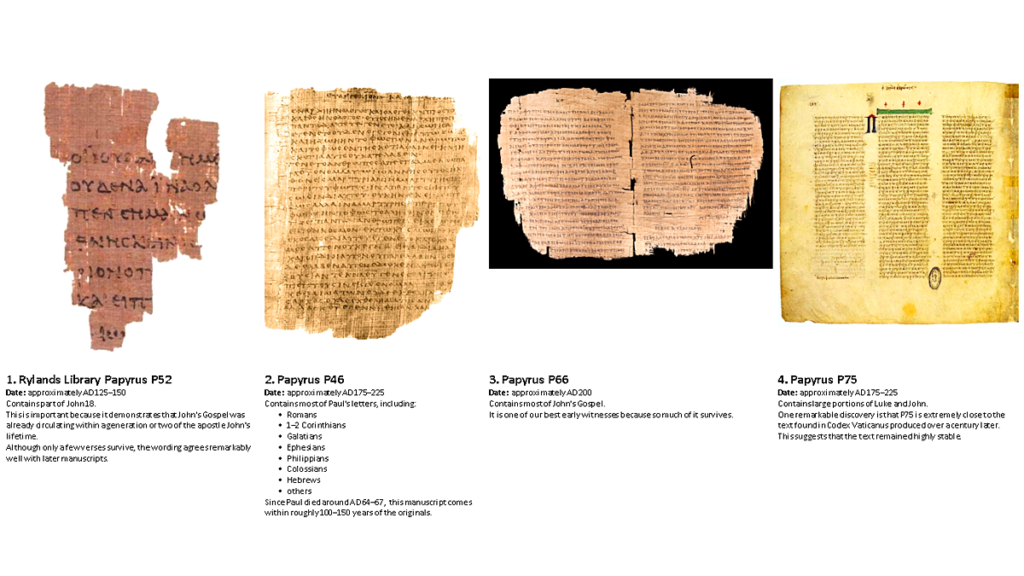
Papyrus P46 — c. AD 175–225 • Pauline Epistles • Chester Beatty Library (Dublin) & University of Michigan Library.
Papyrus P66 — c. AD 200 • Gospel of John • Fondation Martin Bodmer, Switzerland.
Papyrus P75 — c. AD 175–225 • Gospels of Luke & John • Vatican Apostolic Library.
e.g. People Besmirching The Trustworthiness Of THE HOLY BIBLE, “…PROBABLY SOME MEDIEVAL MONK ADDED THINGS OR TOOK THINGS AWAY.” Listen to the full series here: ENTER
Editorial Note:
Dr. Bahnsen’s reference to “about 50 years” is best understood as an approximate description of the earliest surviving manuscript evidence for the Gospel of John. Most scholars date John’s Gospel to around AD 90–95, near the end of the apostle John’s life. The earliest surviving fragment of that Gospel, Papyrus P52, is commonly dated to AD 125–150, placing it roughly 30–60 years after the Gospel was written. In historical terms, that is an exceptionally short gap for an ancient document. While the earliest surviving manuscripts for other New Testament books are generally somewhat later, the New Testament as a whole is supported by an extraordinary number of early manuscripts that enable scholars to compare copies across centuries and reconstruct the original text with a high degree of confidence.
If you’ve ever wondered whether centuries of hand-copying quietly corrupted the message somewhere along the way, whether the Bible on your shelf still says what the apostles actually wrote, you’re not asking an unreasonable question. No one owns the original manuscript of Paul’s letter to the Romans. Every Bible in print descends from copies of copies of copies. Doesn’t that gap undercut the whole argument?
It’s a fair question, and it has a stronger answer than most people expect. Start with the sheer number of manuscripts involved. For most ancient writings, historians work from a small handful of copies, sometimes fewer than ten, often written centuries after the original. Julius Caesar’s own war journals survive in fewer than a dozen manuscripts, the earliest copied roughly nine hundred years after he wrote them, and no historian treats that as a reason to doubt Caesar wrote them. The New Testament survives in a completely different league: thousands of Greek manuscripts, plus thousands more in Latin and other early translations, some dated within a couple of generations of the events they describe.
No other document from the ancient world comes close.
This abundance creates more places for small differences to creep in through ordinary copying: a misspelled word here, a skipped line there. That’s true, and it’s exactly why a field called textual criticism exists. Scholars compare them against each other, line by line, tracing families of copies back toward their earliest ancestors, the way a genealogist traces a family tree through generations of records. When a difference shows up, they can usually explain how it happened and figure out which reading came first. The overwhelming majority of these differences are spelling variations or word order, the kind of thing that wouldn’t even survive translation into English. Only a small fraction affect meaning at all, and virtually none touch a major doctrine that doesn’t also stand on other, uncontested passages.
This cuts the opposite direction from how it first sounds. The existence of textual variants isn’t evidence we can’t know what the Bible originally said. It’s evidence of the opposite: we have so much textual material, spread across so many centuries and regions, that scholars can cross-check one copy against another and reconstruct the original wording with remarkable confidence. A single, lonely manuscript would leave no way to catch a scribe’s mistake. Thousands of independent copies, compared against each other, make mistakes easy to spot and correct. The abundance of copies is the safeguard, not the problem.
None of this proves Scripture is inerrant on its own. That’s a separate claim, resting on what the Bible says about itself. What this evidence does is close off a different objection: that the text we’re arguing about isn’t even reliably the text the apostles wrote. It is. The chain of custody holds. Whatever you decide about the case for sola scriptura, you’re at least arguing about what Paul, John, and the other biblical writers actually said.
Is “Scripture Alone” Itself Just a Tradition?
By now a fair question has probably occurred to you, and Bahnsen took it seriously rather than brushing it aside. If sola scriptura matters this much, why doesn’t that exact phrase appear anywhere in the Bible? Doesn’t that make “Scripture alone” exactly what its critics say it is: a Protestant tradition dressed up in biblical language, no different in kind from the traditions Rome defends?
It’s worth noticing who raises this objection loudest. Converts moving from Protestant churches toward Rome or Eastern Orthodoxy lean on it often, and the first time you hear it, it can sound devastating. If every doctrine has to be provable from an explicit verse using its exact wording, and “Scripture alone” never appears as a phrase in Scripture, the doctrine seems to refute itself the moment anyone tries to defend it.
But notice the hidden assumption. It assumes sola scriptura means every doctrine must show up as an explicit sentence somewhere in the text, word for word. Nobody who has seriously studied the doctrine holds that view. The claim was never that Scripture has to use the phrase “Scripture alone.” It means that Scripture functions as the final test for every other rival authority: church councils, ancient writers, personal religious experience, and yes, even Protestant confessions themselves. The Westminster Confession doesn’t ask to be believed because it’s the Westminster Confession. It asks to be tested against Scripture, and discarded wherever it fails that test.
That pattern runs through the Bible itself, long before any Reformer coined a Latin phrase for it. In Berea, Luke describes the Bereans as more noble than believers elsewhere for one specific reason: they searched the Scriptures daily to check whether Paul’s own preaching held up (Acts 17:11). Not tradition. Not apostolic office by itself, though Paul certainly held that office. Scripture functioned as the test, even for an apostle’s teaching, the same instinct behind checking “well, my pastor says” against the actual passage, just carried all the way up to an apostle’s own preaching.
Everyone has the legitimate right to ask: how do you
Greg L. Bahnsen: Sola Scriptura
know that’s apostolic tradition?
Critics sometimes point to the New Testament’s own use of the word “tradition” as though it settles the argument for them. Paul does tell readers to hold fast to what he delivered to them, by word of mouth or by letter (2 Thessalonians 2:15). Doesn’t that prove tradition carries independent weight alongside Scripture, exactly as Rome insists?
It would, if the word meant the same thing in both mouths. In the ancient world, an apostle functioned something like an authorized representative. When he spoke in that role, his word carried the authority of the one who sent him, the way an ambassador speaks for the government behind him. Jesus makes this explicit when he tells his followers that whoever receives them receives him (Matthew 10:40). That’s what “tradition” meant on an apostle’s lips: the message handed down from Christ by his authorized representatives, now fixed permanently in the documents those apostles left behind. It isn’t a stream of new revelation still capable of adding fresh doctrine centuries later. Hebrews puts the timeline plainly: God spoke through the prophets in many times and many ways, but has now spoken through his Son, the final and fullest word (Hebrews 1:1–2). Rome’s tradition claims to still be growing. The New Testament’s tradition claims to have already arrived, complete, in Christ and in what his apostles wrote. Two different things wearing the same English word.
History adds flesh to what could otherwise feel like an academic dispute. When Martin Luther stood before the Diet of Worms and was told to take back his teaching, he asked for a night to think it over. He came back with an answer that’s outlived every empire in that room: he would not recant unless convinced by Scripture or plain reason, because his conscience was bound to The Lord’s word. He wasn’t claiming private inspiration or the authority to invent new doctrine. He was claiming that nothing standing above Scripture had the right to bind his conscience. That’s the entire content of sola scriptura, spoken by one man under real pressure with real consequences attached to getting it wrong.
Living Under the Final Word

Step back and look at what these three lectures build together. Rome’s two-source system quietly promotes tradition above the very text it was supposed to serve. A Bible with real errors can’t hold the weight of final authority no matter how highly you speak of it, because something else always has to be recruited to screen out its mistakes. The manuscript evidence closes off the objection that we can’t even know what the biblical writers said. And the doctrine defending Scripture’s unique authority isn’t itself an arbitrary human tradition. It’s the same appeal to Jehovah’s own word that Christ made, that the Bereans made, that Paul urged on Timothy, long before anyone needed a Latin phrase to describe it.
Put those pieces together and the question stops being theoretical. It becomes personal fast, closer to home than a seminary debate. Think again of that husband and wife, still disagreeing over the passage in front of them. When a pastor’s reading, or a denomination’s confession, or the consensus of scholars, or your own gut sense of what a loving God would surely say, runs into conflict with what the text actually teaches, something has to give. Sola scriptura says which one that should be. It doesn’t make human teachers worthless; faithful voices have always helped the church understand hard questions. It means every one of those teachers has to answer to the text. None of them gets to answer for it.
We are not to be held captive to the wisdom of men,
Greg L. Bahnsen: Sola Scriptura
but rather to The Word of God.
That’s not a small point reserved for seminary electives. It’s the hinge every other doctrine turns on, because every doctrine eventually gets defended by an appeal to some authority. If that authority can shift depending on convenience, or on whichever voice sounds most persuasive at the moment, no doctrine is secure, including the ones you happen to like. Scripture alone is what keeps the whole structure standing on rock instead of sand.
Epilogue: Where This Argument Was Forged
This argument doesn’t end here. Below, Dr. Bahnsen’s own complete lecture series carries the case for Sola Scriptura in far greater depth, working through what was touched on in the article, and in his own words.
Sola Scriptura did not arrive on its own. It was forged inside the Reformation itself, in real conflicts with real consequences. The recommendations that follow were chosen to carry that story forward as the historical grounding of this article’s message.
Sola Scriptura
The issue of authority is at the heart of every worldview. Dr. Bahnsen sets forth the necessity of an inerrant and sufficient Bible for true Christianity and challenges the trustworthiness of all other claims to authority.
Recommendations:

Brief Synopsis of the Reformed Faith
Dr. Bahnsen offers a great summary of the Reformed faith-very useful for those who want a quick overview. (ENTER)
The Reformation
In one passionate sermon, Dr. Greg Bahnsen succeeds both in delivering the salient points of the 16th century Protestant Reformation, and challenging Christians to continually reform to serve GOD with greater consistency and obedience. (ENTER)
The Distinctives of the Reformed Faith
What does it mean to be theologically “Reformed”? It is not easy to offer a concise, full and clear summary. This is one of Dr. Bahnsen’s most frequently requested series and a great teaching tool in doctrine. Explains how the Reformed outlook differs from others. (ENTER)
Christianity in a League of Its Own (4 of 4)
Yes, you not only can, you must defend the faith. Apologetics is for every believer and every believer can learn how to do the job well. (ENTER)
Calvin’s Institutes of the Christian Religion
There is nothing comparable to this course of study to be found anywhere. If you are interested in advanced theology, here is the place to start. Dr. Bahnsen offers a masterful and detailed study of Calvin’s masterpiece of Reformed theology: Calvin’s Institutes of the Christian Religion (Ford Lewis Battles translation, J. T. McNeill, ed.).This second album of cds covers Book II, Chapter 1 through Chapter 16. (ENTER)
New to The Bahnsen Bible Academy?
If you’re new to the Academy, this brief introduction explains our mission and how these articles, videos, and lecture series are designed to help you study the teaching ministry of Dr. Greg L. Bahnsen.