


Introduction: When “Good Causes” Go to War
There are few things more persuasive to the human conscience than a good cause. The defense of the weak, the restraint of tyrants, the preservation of peace. These aims carry an intuitive moral force. They sound righteous. They feel necessary. And yet, as history shows, interventionist wars waged in the name of such causes often leave behind devastation, disillusionment, and unanswered ethical questions. The problem is not simply that these wars can go wrong, but that we often fail to ask whether we have the authority to wage them.
It is precisely at this point that the teaching of Greg L. Bahnsen becomes both unsettling and necessary. In his lecture on Interventionism, Bahnsen does not begin with strategy, geopolitics, or national interest. He begins with a far more foundational issue: What has the Lord authorized? And if that question is not asked and answered, then even the most noble-sounding war may stand condemned before heaven.
If you are military age, this is not a remote issue. It may soon be your own.
TBBA Editorial Position: A Necessary Word Before We Proceed
A word of clarity is required as we engage Bahnsen’s argument. The Bahnsen Bible Academy is committed to faithfully presenting the teaching of Greg L. Bahnsen while also insisting that Scripture alone is the final authority. No teacher, however careful or brilliant, is infallible. Therefore, you are not called to passive agreement, but to active discernment under the Word of God.
This means that the material presented here must not only be understood. It must be weighed. The moral responsibility for what we believe, support, or justify cannot be transferred to scholars, governments, or traditions. Each person stands before the Judge of all the earth. And that accountability grows especially heavy when the subject is war, where decisions are measured not only in arguments, but in blood.
The Principle of Lawful Jurisdiction
At the heart of Bahnsen’s argument lies a principle both simple and profound: those who wield coercive power must remain within their God-given jurisdiction. The state, according to Scripture (Romans 13:4), is authorized to bear the sword—but that authority is not without limits. It is not absolute. Its reach is not global in scope. It is defined and restrained by The Lord Himself.
To illustrate this, Bahnsen draws from everyday moral reasoning. A neighbor may be mistreating his child, yet no one assumes that another private citizen has the right to forcibly enter that home and administer discipline. A church may fall into error, yet another church does not possess the right to impose discipline upon it. In each case, the issue is not whether wrongdoing exists, but whether one has the rightful authority to intervene through coercion.
I would be much happier if the United States of America paid a great deal more attention about protecting me here at home than in worrying
Greg L. Bahnsen: Interventionism
about oil grabbing in the Middle East…That isn’t the
lawful jurisdiction of this country.
This distinction also clarifies something essential. Scripture does not forbid all uses of force (Genesis 9:6)(Exodus 22:2). The defense of one’s own life, people, and lawful domain stands on a different footing than intervention abroad. The question, therefore, is not whether force may ever be used, but whether it is used within the limits the Lord has appointed.
A principle like this, though widely understood in personal and ecclesiastical contexts, is often abandoned when applied to nations. Suddenly, evil elsewhere is treated as sufficient justification for military action. But Bahnsen presses the question: Where has God granted one nation the right to act as the enforcer of justice in another? If such authorization cannot be found, then intervention—no matter how well-intentioned—ceases to be justice and is revealed as injustice.

A Confronting Analogy: The Cost of “Good Intentions”
At this stage, Bahnsen uses an analogy to strip away abstraction and expose the ethical reality beneath interventionist rhetoric:
It’s one thing for me to say I will sacrifice my security, freedom, money, and well-being for a good cause. And another thing for me to
Greg L. Bahnsen: Interventionism
very simply tell others to do it for me…
Politicians who choose intervention by war are expending the lives, the money, and the freedom of others… And that’s what I’m asking for a moral justification for. And I don’t see it in the Bible.
Greg L. Bahnsen: Interventionism
Here the conversation becomes unavoidable. War is not an abstraction. It involves the taking of life, the destruction of property, and the coercion of citizens. According to Scripture, such actions require clear biblical warrant. Without it, they are not less tragic. They are unjust.
The End Does Not Justify the Means
One of Bahnsen’s most consistent refrains is a principle that Christians readily affirm in theory but frequently abandon in practice: the end does not justify the means. It is not enough to identify a good outcome. One must also ask whether the path to that outcome has been approved by The Lord.
To illustrate this, Bahnsen offers a deliberately absurd example: a church that desires more resources for ministry decides to rob local banks. The goal is good. The outcome could even be beneficial. But the means are forbidden. And therefore, the action is immoral.
Yet when nations pursue war, this same reasoning is suspended. The presence of tyranny, oppression, or instability is treated as sufficient justification for military intervention. But Bahnsen insists that this is a fundamental category error. The issue is not simply, Is the goal good? The real question is, Has God authorized this means to achieve it? If the answer is no, then the action stands condemned, regardless of its intentions.

Accountability Before God: No One Is Exempt
If Bahnsen is correct that unjust war constitutes the unlawful taking of life and property, then a pressing issue emerges: Who is accountable? It is here that the discussion must be pressed further, because the answer cannot be reduced to a single level of responsibility.
Personal accountability for war is not evenly distributed, but neither is it absent at any level. Those who declare and authorize war bear the greatest weight before the Lord—a pattern consistent with Scripture’s teaching that “to whom much is given, much will be required.”(Luke12:48) Those who design and execute military strategy share in that burden. And those who carry out orders, though often constrained by circumstance and authority, are not thereby rendered morally neutral. If you are considering military service, this includes you.
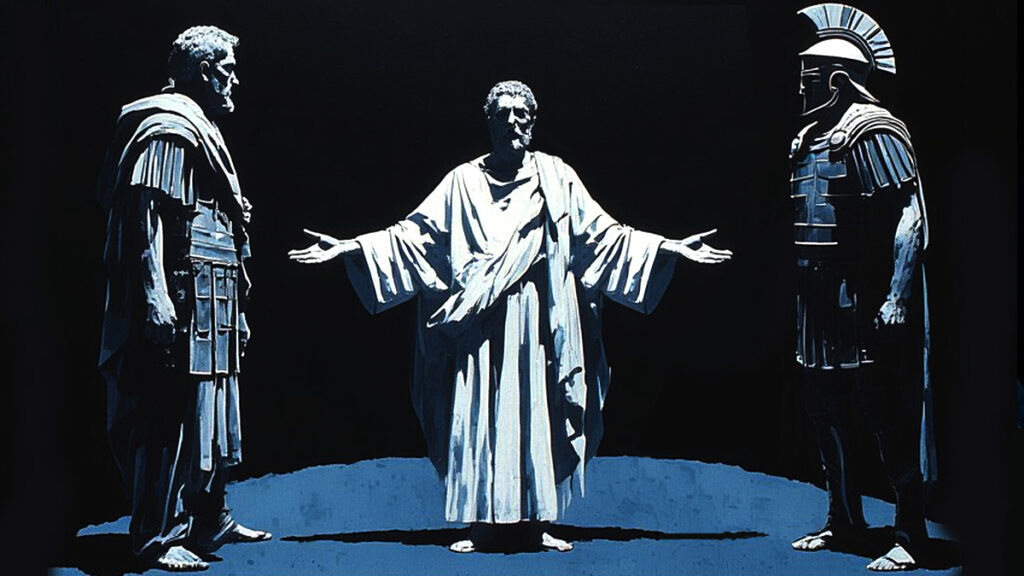
Scripture itself refuses to isolate accountability to one sphere. Consider the ministry of John the Baptist. He did not hesitate to confront political authority, rebuking Herod Antipas with the words, “It is unlawful for you to have your brother’s wife” (Mark 6:18). Yet he also addressed individual soldiers, commanding them, “Do violence to no man, neither accuse any falsely; and be content with your wages.” (Luke 3:14). The implication is inescapable: God’s moral law speaks both upward and downward—binding rulers and those who serve under them alike.
In times of crisis, ignorance is not an excuse. Every Christian has a duty to understand the war he may be asked to fight.
Contact the Center on Conscience & War if you’re in the US military and want to seek discharge or reassignment as a Conscientious Objector.
The weight of this responsibility falls most heavily upon the one who is called to fight. The soldier is not a distant observer. He is the one who will be commanded to take life and to risk his own. For that reason, he cannot afford to be ignorant. While it is true that political leaders bear primary responsibility for the initiation of war, it does not follow that those who participate in that conflict are thereby absolved. Each individual remains accountable before the Lord for his actions, and no appeal to authority removes that burden.
This is why the Christian cannot retreat into passive ignorance. As argued, loyalty to one’s nation is never meant to be blind or mechanical. God alone is Lord of the conscience. That means no government, no commander, and no national cause can relieve a man of his responsibility to think, to judge, and to act.
Bahnsen then makes a sobering observation: while the United States Supreme Court has recognized limited forms of conscientious objection, it does not recognize the right to refuse participation in a particular war on the grounds that it is unjust.
For this reason, in times of national crisis, this responsibility is especially urgent for those of military age. You are not permitted to say, “I did not know.” You are not permitted to say, “I was just following orders.” You are required to become a student of the conflict you may be asked to enter, because the moral weight of that participation will rest on you.
And if, after honest consideration, a Christian is convinced that a war is unjust, the obligation does not disappear—it intensifies. He must protest. If necessary, he must refuse participation. If you reach that conviction, you must not turn from it, whatever the consequences. Scripture does not permit obedience to human authority when that authority commands what The Lord forbids. The early disciples made this clear when they declared that obedience to God must come before obedience to men. That principle does not vanish in times of war. It is imperative.
Those who carry out orders, though often constrained by circumstance and authority, are not thereby rendered morally neutral.
Responsibility is layered—but it is never erased.
A Present Application: War, Law, and Moral Legitimacy
These questions are not confined to history. They press upon us in the present moment. In light of recent tensions involving the United States and Iran, a growing number of legal scholars and constitutional analysts have raised serious concerns regarding the lawfulness of military action by the United States.
The U.S. Constitution places the authority to declare war not in the executive branch alone, but in Congress. By no means is this a minor detail—it is a binding constitutional requirement and a structural safeguard designed to prevent the illicit use of military force. When that process is bypassed, the issue is no longer merely political. It is constitutional and moral.
Many within the legal community argue that U.S. military actions against Iran lack the required authorization. If that assessment is correct, then the implications are gravely serious. A war initiated without lawful authority cannot be assumed to possess true moral standing.
For the Christian, this raises a matter that cannot be ignored. If the war itself stands on uncertain legal and constitutional ground, then participation is no longer shielded by presumed legitimacy, and the ethical burden placed upon those who are asked to fight or refuse to fight falls far more heavily upon them.

A Judgment That Must Be Faced
We are now brought to a difficulty that cannot be avoided—one that Greg L. Bahnsen himself does not fully resolve. On the one hand, he argues that interventionist wars may be without biblical warrant. And on the other, he expresses support for the troops who carry them out, placing primary responsibility upon political authorities.
This distinction is not without merit. Those who make decisions at the highest levels of power will face a stricter judgment. And yet, the question remains: Can moral obligation be so cleanly divided? If a war is unjust, then participation in it cannot be treated as of no real moral consequence. At the same time, the realities of duty, coercion, and limited knowledge complicate any simplistic judgment.
Scripture does not permit us to declare all participants equally guilty. Neither does it allow us to declare any participant entirely innocent. Instead, it places every individual—ruler, commander, and soldier alike—within the limits of the authority appointed by the Lord. The end does not justify the means, and good intentions cannot make an unjust act righteous.
In an age of endless war, this tension presses with irresistible force. Interventionist wars waged in the name of “good” have left in their wake unimaginable physical and spiritual suffering. And while Scripture does not forbid the defense of one’s own people and rightful jurisdiction, it does not grant nations a blank check to wage war beyond those bounds. Where that authority is exceeded, accountability does not disappear—it deepens.

Epilogue: A Call to Listen, Not Merely Read
This article is not a substitute for the lecture, but an invitation to wrestle with it.
There is only so much an article can do. The weight of these arguments, and the force with which they are presented, are best encountered directly in the teaching of Greg L. Bahnsen. His lecture on Interventionism is not a casual reflection. It is a sustained moral challenge that demands careful listening and serious consideration.
Do not stop here. Let this be your starting point.
Listen to the lecture. Follow the argument. Examine it in the light of Scripture. And then ask yourself with renewed urgency:
By what standard do we justify war?
Because that question is not merely theoretical.
Every nation and every person must give an answer.
Recommended:
Continue the Study: War, Scripture, and Christian Ethics
If this article has raised questions, do not stop here. Work through the issue more deeply in the following lectures.
Series: The Christian View of War
• The Source of Wars — James 3:13–4:10 (1 of 3)
• The Conducting of Wars — Deuteronomy 20 (2 of 3)
• The End of Wars — Isaiah 2 (3 of 3)
Additional Lectures
• War: A Spiritual Failure
• Holy War, Just War
• War: Is It Ever Justified?
• War
• Pursuing the Pacifist’s Ideals
• Welfare and Warfare: Should the Government Do It All? (1 of 4)
• Theonomic View of Warfare (16 of 21)
• Just War Theory (3 of 3)
Study Resource
• PDF Study Guide
A Christian View of War